





Long before rainbow flags and modern LGBTQ+ language, Indigenous nations had their own understandings of gender, sexuality, spirituality and community. That history reaches from Native nations across Turtle Island to Tongva land here in Long Beach—and continues this October with the return of Indigenous Pride LA.
Most of us were taught a version of LGBTQ+ history that begins with Stonewall. We hear about the riots, the marches that followed and the fight for visibility that eventually became what we now call Pride.
That history matters. But gender and sexual diversity on this continent did not begin in 1969—or with the arrival of Europeans, for that matter.
Long before the United States existed, Indigenous nations had their own languages, family structures, spiritual teachings and ways of understanding gender. Many recognized people whose identities or community roles did not fit within the strict male-female and heterosexual boundaries that Europeans later imposed.
Today, some Indigenous people use the term Two-Spirit to describe identities that may bring together gender, sexuality, culture, spirituality and responsibility to community. It is also where the “2S” comes from in 2SLGBTQ+.
The more I researched this history, though, the more important one point became: Two-Spirit is not simply an Indigenous word for gay, transgender or nonbinary. It is not one identity shared in the same way by every Native nation. And it is not a term non-Indigenous people can claim.
It carries a history that belongs to Indigenous people.
There Was Never One Indigenous Understanding of Gender
There are hundreds of distinct Indigenous nations across North America. Each has its own language, traditions and teachings, so there was never one universal Indigenous system of gender.
Some nations recognized three, four or more genders. Others had specific names for people who crossed gender roles, formed same-gender relationships or carried particular ceremonial, family or community responsibilities.
People we might now place under the Two-Spirit umbrella have been described as healers, artists, teachers, caregivers, mediators, medicine people and keepers of cultural knowledge. But the roles differed from one nation to another, and not every gender-diverse Indigenous person held a spiritual or ceremonial position.
That distinction is easy to lose. There is a tendency to talk about every Two-Spirit person as having carried the same sacred role, which can become another way of flattening hundreds of different cultures into one story.
The Canadian Museum for Human Rights points to Indigenous languages with several different expressions for people whose gender or social roles did not fit within a male-female binary. Cree alone contains multiple terms. So does Anishinaabemowin.
Those words did not necessarily mean the same thing, and they should not all be translated backward into “Two-Spirit.” Some described how a person dressed or lived. Others referred to social roles, spirituality, relationships or gender.
Colonization Reached Far Beyond the Land
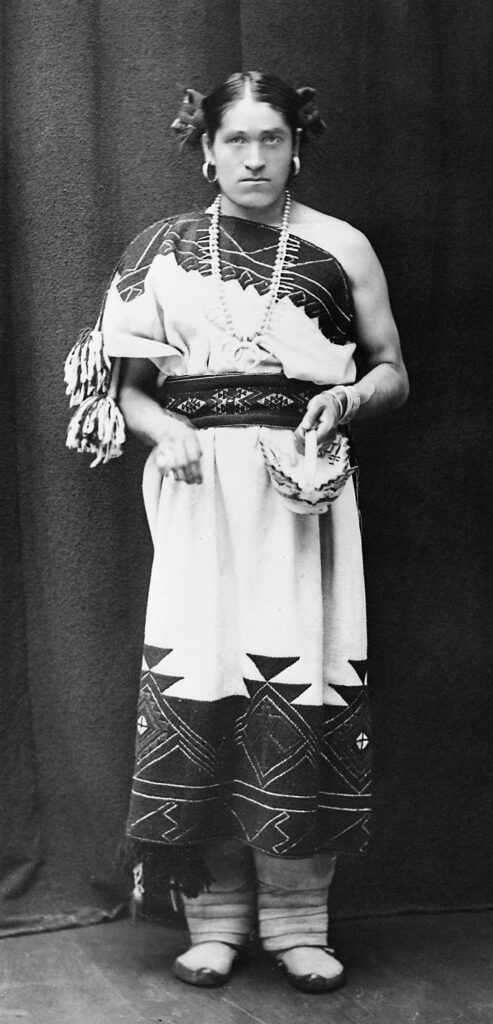
European colonization was about taking land, but it also reached directly into people’s homes, relationships, ceremonies and bodies.
Christian missionaries and colonial governments attempted to reorganize Indigenous life around heterosexual marriage, patriarchy and a rigid division between men and women. Indigenous gender systems and same-gender relationships were treated as proof that Native people needed to be converted and “civilized.”
Ceremonies were outlawed. Languages were punished. Children were taken from their families and placed in boarding or residential schools.
Even today, not every Indigenous LGBTQ+ person identifies as Two-Spirit. Someone may identify as gay, lesbian, bisexual, trans, queer, nonbinary, Indigiqueer, Two-Spirit or some combination of those identities.
Inside those schools, children were divided into male and female categories. Their clothing, hair, work and behavior were controlled according to European Christian expectations. Young people who expressed gender or sexuality outside those expectations could face severe punishment.
The damage did not stay inside the schools. Over time, colonial ideas about gender and sexuality were also absorbed into Native communities. Older teachings were pushed underground, forgotten or replaced by Christian homophobia.
Researchers including Gregory D. Smithers, Mark Rifkin, Scott Morgensen and Sarah Carter have connected this regulation of gender, marriage and sexuality to the larger colonial attack on Indigenous sovereignty. The Canadian Museum for Human Rights also explains that controlling intimate and family life was part of how colonial governments attempted to control Indigenous nations.
By the middle of the 20th century, many people we might now call Two-Spirit had been forced into hiding—even within their own communities.
But they did not disappear.
A New Name With a Much Older History
The traditions are much older than the term itself.
The name Two-Spirit was embraced in 1990 during the Third Annual Intertribal Native American, First Nations, Gay and Lesbian Conference near Winnipeg, Manitoba.
According to the history documented by the Canadian Museum for Human Rights, Cree organizer Myra Laramee shared a dream in which spirits shifting between male and female forms described her with the Anishinaabemowin words niizh manidoowag. The expression was translated into English as “Two-Spirit” or “Two-Spirited.”
People attending the gathering discussed and eventually embraced the term. They were looking for language that could connect contemporary LGBTQ+ experiences with Indigenous traditions and replace an offensive label long used by missionaries and anthropologists.
There was already a movement building before that gathering. Gay American Indians was founded in San Francisco in 1975, followed by Native LGBTQ+ organizations in Minneapolis, Toronto, New York, Winnipeg and other cities.
Queer Indigenous organizers often found themselves pushed to the edges of two different movements. Mainstream gay liberation spaces could be racist and largely ignored the ongoing reality of settler colonialism. At the same time, some Native political movements had absorbed Christian homophobia and rigid ideas about masculinity.
Two-Spirit organizing created room for a different conversation—one in which sexuality and gender could not be separated from Native identity, culture, land and sovereignty.
The term spread during the 1990s, but it was never meant to replace traditional nation-specific language. It became a way for people from different Native nations to gather, organize and heal together.
That is part of what makes Two-Spirit difficult to fit into a quick definition. It can describe an identity, but it is also connected to a larger movement of cultural reclamation and Indigenous self-determination.
What This History Means in Long Beach
Writing about this locally required some care.
Long Beach is part of the homelands of the Tongva people. Puvungna, located around what is now Cal State Long Beach and Rancho Los Alamitos, was a major village and remains a sacred place of ceremony and gathering.
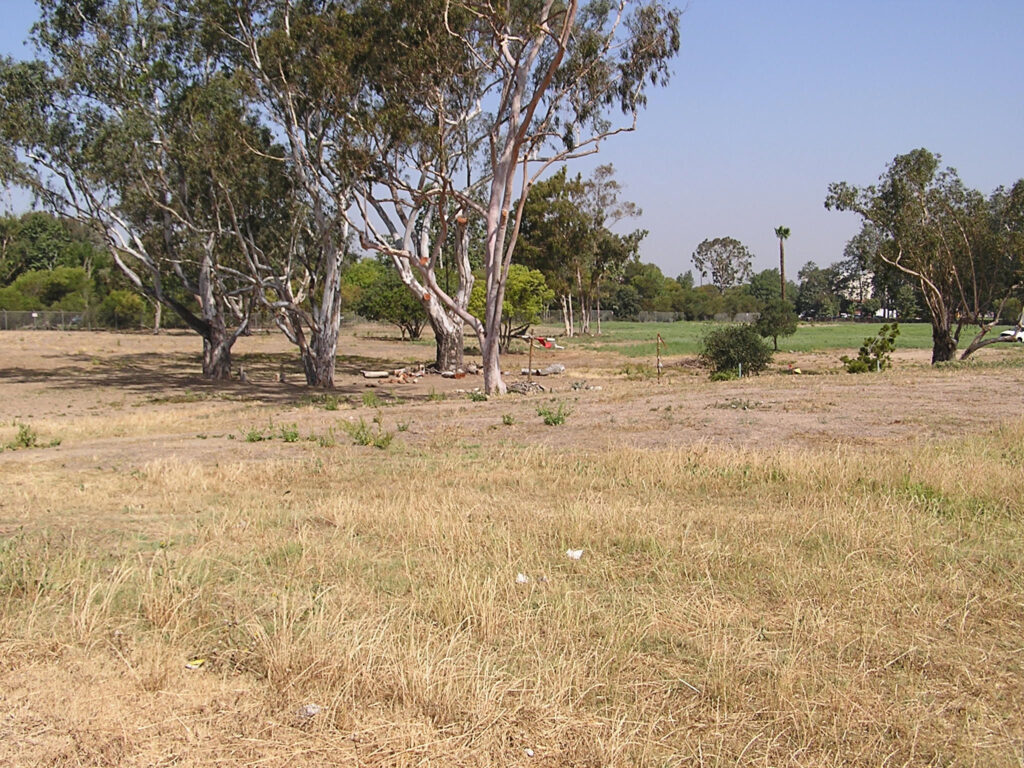
The surviving undeveloped portion of Puvungna on the CSULB campus is listed on the National Register of Historic Places and the California Native American Heritage Commission’s Sacred Lands Inventory. It continues to hold significance for Tongva, Kizh, Acjachemen and other Native communities. CSULB maintains additional information about the land and its continued ceremonial use.
One of the questions I had while working on this article was whether the Tongva had a documented traditional term that could be presented as an equivalent to Two-Spirit.
I could not verify one that is widely accepted, and I do not think it would be responsible to fill that gap with an assumption.
Much of what Europeans recorded about Native gender and sexuality in California came through missionaries who were already trying to destroy those traditions. Native languages and cultural knowledge were suppressed before they were fully documented by the people who actually lived them.
The absence of a surviving written term does not prove gender-diverse Tongva people did not exist. It tells us something about who was allowed to record history—and what colonization erased along the way.
The contemporary Tongva connection is much clearer.
Artist, culture keeper and language advocate L. Frank Manriquez identifies as a Two-Spirit person of Tongva, Ajachmem and Rarámuri descent. Her work has focused heavily on challenging the erasure of California Native people and keeping cultural knowledge visible.
In an interview with the Natural History Museum of Los Angeles County, L. Frank talks about art as a way of addressing that invisibility. She also speaks about finding community through the Bay Area American Indian Two-Spirits and the importance of reconnecting people with identities that Christianity attempted to remove from Native life.
Long Beach also has a direct connection to modern Two-Spirit organizing through the City of Angels Two-Spirit Society, or CATSS.
CATSS formed on Tongva land in the Los Angeles Basin in late 2012. Its first meetings were held at United American Indian Involvement in Los Angeles, and subsequent meetings were hosted at The LGBTQ Center Long Beach.
The organization was created because community members wanted a more inclusive space for Indigenous lesbian and bisexual women, Two-Spirit people and their families, in addition to programs already serving Native gay men and trans feminine people.
There is another Long Beach connection through CATSS co-chair Gabriel Estrada, a Caxcan/Xicanx professor at Cal State Long Beach who teaches queer spirituality, Indigenous studies and Nahuatl literature.
These are living connections. They make this more than a history that happened somewhere far away. Long Beach is home to sacred Native land, contemporary Indigenous cultural leaders and people who helped build the modern Two-Spirit community in Southern California.
Indigenous Pride LA Is Back This October
That work will be visible again this fall when Indigenous Pride LA returns on Sunday, October 11, 2026, at Exposition Park.
Founded in 2018, Indigenous Pride LA is the only Pride organization and celebration of its kind in the Los Angeles region specifically centering Two-Spirit, Indigiqueer and Indigenous LGBTQPAI+ people.
After several years apart, the festival returns with the theme:
“The Radiance of Our Steps: Pride Blooms Where We Dance!”
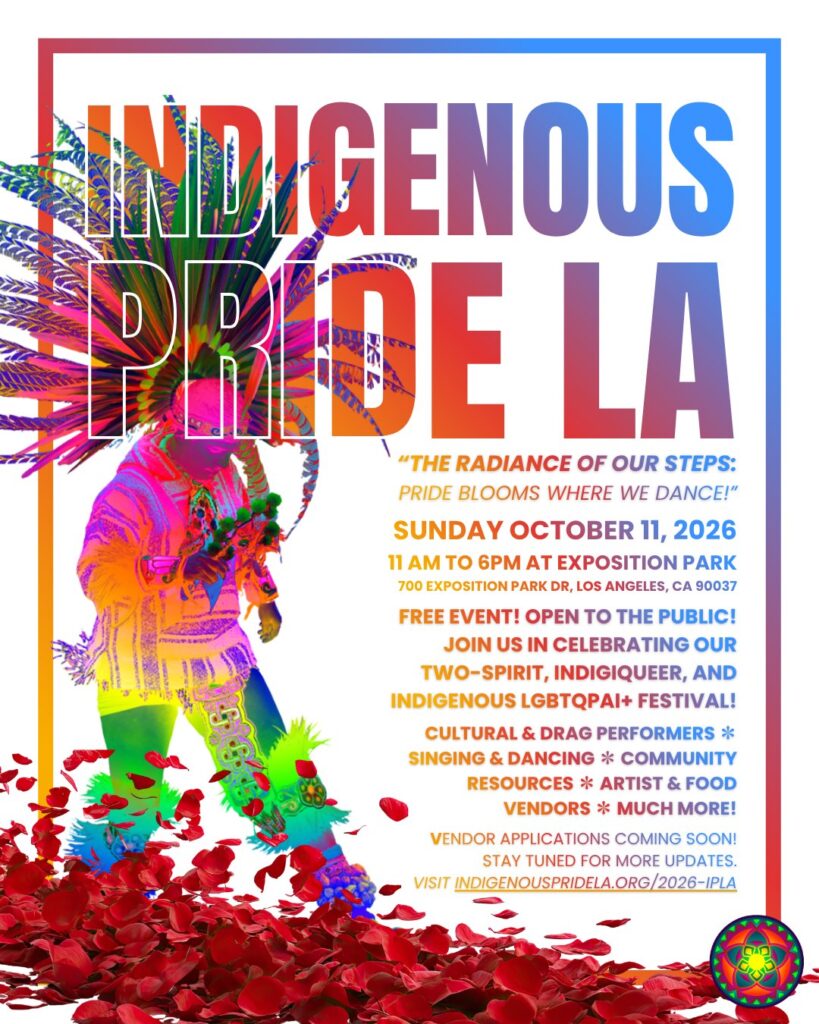
I love the meaning behind this year’s theme. The organization describes dancing as more than movement. Every step carries stories, teachings and traditions between ancestors, living relatives and future generations.
The free, family-friendly intertribal gathering is expected to bring together traditional and contemporary performances, dancing, singing, storytelling, drag, Indigenous artists, food vendors, community organizations, educational programming and health resources.
Everyone is welcome, but Indigenous people remain at the center. That distinction matters, especially when Native and Two-Spirit people are still frequently treated as an afterthought within larger Pride spaces.
The celebration takes place one day before Indigenous Peoples Day. That timing connects queer visibility with something much larger: Native survival, cultural reclamation and sovereignty.
I started this research wanting to better understand the history behind a term we are seeing more often. What I found was not one simple definition or one story shared by every Native nation.
It is a history of traditions that existed long before our current LGBTQ+ language. It is also a history of what colonization tried to erase, what Native people kept alive and what Two-Spirit communities are actively rebuilding today.
Two-Spirit history did not begin with Pride. But this October, Pride becomes one more place where that history can be remembered, celebrated and carried forward.
2026 Indigenous Pride LA
Date: Sunday, October 11, 2026
Time: 11 a.m.–6 p.m.
Location: Exposition Park, South Lawn, 700 Exposition Park Drive, Los Angeles
Admission: Free and open to the public
Information: 2026 Indigenous Pride LA
Further Reading
- Gregory D. Smithers, Reclaiming Two-Spirits: Sexuality, Spiritual Renewal, and Sovereignty in Native America
- Mark Rifkin, When Did Indians Become Straight? Kinship, the History of Sexuality, and Native Sovereignty
- Ma-Nee Chacaby with Mary Louisa Plummer, A Two-Spirit Journey: The Autobiography of a Lesbian Ojibwa-Cree Elder
- Scott Morgensen, Spaces Between Us: Queer Settler Colonialism and Indigenous Decolonization
- The History of Two-Spirit Folks — The Indigenous Foundation
- What Is Two-Spirit? Part One: Origins — Canadian Museum for Human Rights
- History — 2-Spirited People of the 1st Nations
RELATED ARTICLES:
FEATURED IMAGE CREDIT: Members of Bay Area American Indian Two Spirits participate in the 2022 San Francisco Pride Parade. | Gabe Classon from Berkeley, California, United States | Gabe Classon, CC BY 2.0, via Wikimedia Commons
Written and researched by Salvador Flores. Enhanced for grammar and clarity with the assistance of AI.